

Last week, Bloomberg published two back-to-back articles on Nigeria’s capital markets.
While the stories centered on Nigeria, together they point to something much larger: African capital markets are increasingly earning the attention and confidence of global investors.
For years, the investment narrative around Africa centered on potential. Today, it’s increasingly about progress.
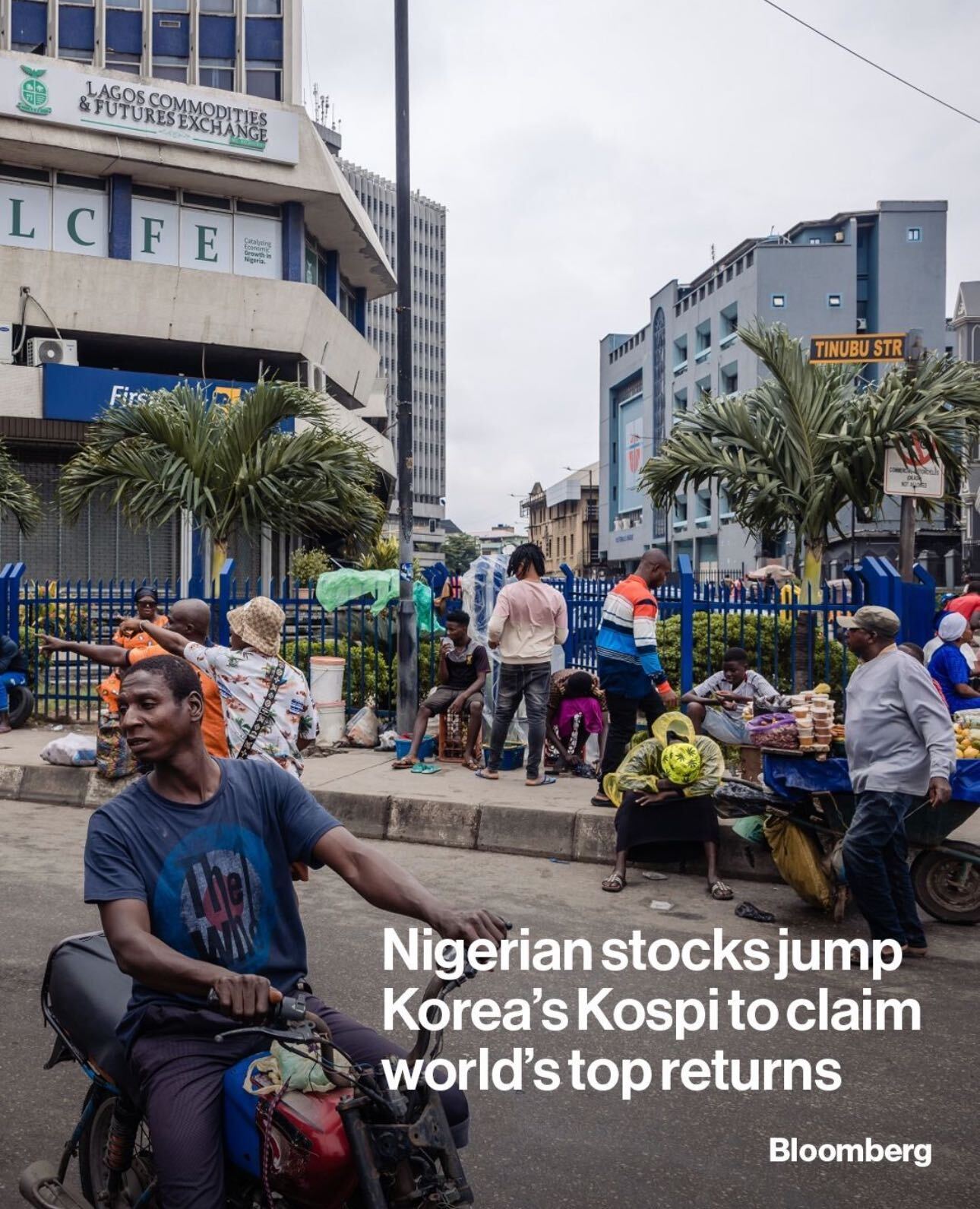
Nigeria’s stock market has returned 68% in U.S. dollar terms this year, making it the best-performing equity market among the 92 exchanges tracked by Bloomberg. While the performance has captured global attention, the bigger story is what it signals: growing confidence in Nigeria’s capital markets, driven by economic reforms, improving liquidity, stronger foreign exchange conditions, and a more stable naira. Bloomberg’s follow-up article reinforced that point by focusing on the market infrastructure supporting that confidence, including settlement efficiency, liquidity, and foreign exchange accessibility as Nigeria works toward regaining Frontier Market status.
Taken together, the articles suggest that investors are looking beyond returns. They’re evaluating whether markets have the institutions and infrastructure needed to attract long-term capital.
A Changing Narrative
For decades, investing in Africa has been defined by demographics, economic growth, and long-term opportunity. Those fundamentals remain compelling.
However, the conversation is beginning to shift.
Instead of asking whether Africa offers attractive investment opportunities, investors are increasingly asking whether its capital markets are ready to support long-term investment.
That shift in perspective changes how markets are evaluated. Institutional investors rarely allocate capital based on one strong year. They look for transparent regulation, reliable settlement, improved liquidity, and predictable market infrastructure.
From Opportunity to Accessibility
Market development is generally categorized into three stages.
First is opportunity, where investors recognize long-term economic potential.
Second is market readiness, where capital markets strengthen the institutions and infrastructure that give investors confidence to commit long-term capital.
Third is accessibility, where modern financial infrastructure makes those markets significantly easier for institutional and retail investors to access.
Nigeria’s recent momentum suggests meaningful progress in market readiness. The next chapter will be defined by accessibility, reducing barriers to cross-border investing and expanding participation.
Why This Matters Beyond Nigeria
Nigeria is an important example, but it isn’t the only market moving in this direction.
Across several African markets, exchanges are modernizing, regulators are strengthening market frameworks, and governments are improving transparency and liquidity.
Financial innovation is becoming part of that broader modernization. Nigeria’s SEC launched an incubation program for digital asset firms, while Ghana’s SEC recently introduced a regulatory sandbox for virtual asset providers. Together, these initiatives reflect a broader effort to modernize market infrastructure and expand investor access.
Progress won’t happen overnight or uniformly across the continent, but the direction across markets is becoming increasingly clear.
Looking Ahead
The bigger takeaway isn’t about one market or one year of strong performance. It’s about the evolution of African capital markets and the foundations being built for long-term investment.
The conversation is shifting from recognizing opportunity to building markets that can support long-term investment through stronger institutions, modern infrastructure, and broader investor access.
Not every market is there yet, and progress won’t happen at the same pace. Across the continent, the building blocks for stronger, more accessible capital markets are steadily taking shape.
If the past decade was about recognizing Africa’s economic potential, the next decade will be about strengthening market readiness and making those opportunities more accessible to global investors.